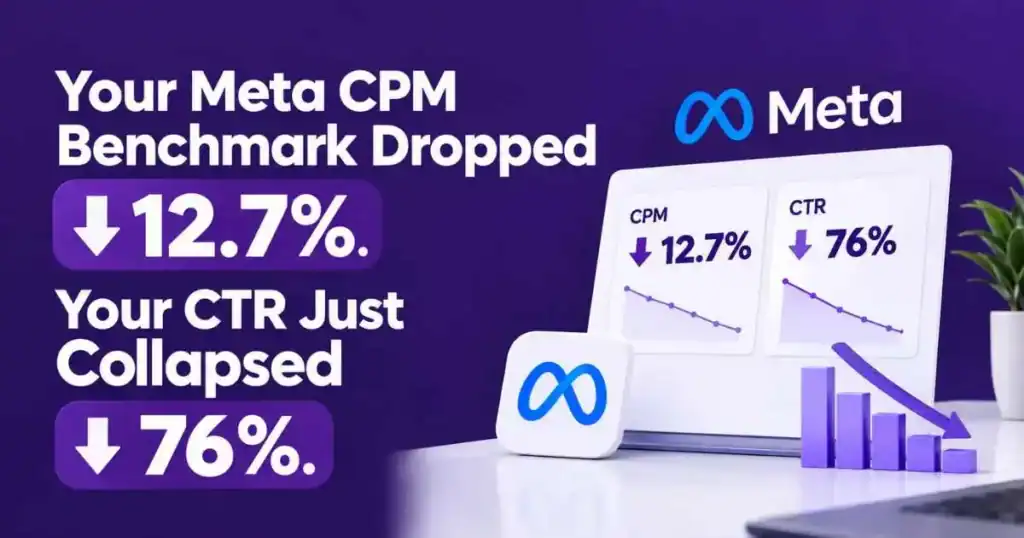
You check your CPM and it’s down. A lot down. By most reasoning, that should feel like good news, more impressions for the same budget, cheaper reach across the board.
Then you check CTR, and it’s collapsed right alongside it.
This isn’t a hypothetical scenario. One documented account in August watched CPM fall from roughly 60 euros to 7 euros while CTR dropped from 3.5 percent to 0.85 percent in the same week, a 76 percent collapse happening at the exact moment costs looked like they were improving. Cheap impressions, worthless traffic. Understanding why this happens, and whether it’s happening in your own account right now, matters more than watching the headline Meta CPM Benchmark number alone
The Meta CPM Benchmark Doesn't Even Agree With Itself
Before getting into the CTR problem, it’s worth understanding that the Meta CPM Benchmark picture right now is genuinely contradictory, depending on which source you’re looking at.
One benchmark tracker covering roughly 3 billion dollars in tracked Meta spend put the median Facebook CPM at 16.47 dollars in July 2026, down 12.7 percent from July 2025, the deepest trough in its 13-month tracking series. That same tracker showed June up 16.5 percent year over year, a sign flip within a single month. Meanwhile, Meta’s own earnings call reported average price per ad rising 12 percent over the same general period.
Both figures can be true simultaneously. Meta’s number is a global average pulled upward by strong ad performance, and the company’s own filing credits impression growth from lower-monetizing surfaces with helping hold prices down elsewhere. A single Meta CPM Benchmark headline number, in other words, can mask two very different things happening at once, rising costs in some surfaces and falling costs in others, netting out to a number that doesn’t clearly describe either.
Why Falling CPM and Collapsing CTR Happen Together
The connection isn’t a coincidence, and it isn’t really a contradiction once you understand the mechanism. A falling CPM often means more available inventory entering the auction, frequently from lower-monetizing, lower-intent placements that were previously less accessible or more expensive to reach.
Community reports tie this specific slump to July 29, the date a new ranking system was reportedly announced, with accounts seeing CPA effects ranging up to 4.7 times worse within the same week. Cheaper impressions sourced from lower-intent surfaces genuinely can cost less per thousand views. They can also convert at a fraction of the rate your previous placement mix did, which is exactly what a falling CPM paired with collapsing CTR usually signals.
This is the trap in reading the Meta CPM Benchmark in isolation. A lower number looks like an efficiency win on its own. Paired with a cratering CTR, it’s actually a placement quality problem wearing a discount sticker.
How to Check If This Is Happening in Your Account
Don’t react to a falling CPM by assuming things are improving. Check CTR from the exact same period first, since a real efficiency gain should show stable or improving CTR alongside the lower cost, not a simultaneous collapse.
Pull your placement breakdown directly and look for a shift toward lower-intent surfaces you weren’t previously seeing as heavily. If a meaningful share of new impressions is landing in placements historically associated with lower engagement, that’s the mechanism behind the falling Meta CPM Benchmark number showing up specifically in your account.
Benchmark against your own trailing months rather than an external average. A published Meta CPM Benchmark figure describes an industry-wide pattern, not your specific account’s placement mix, audience, or creative. Your own historical CPM and CTR trend line is the more reliable comparison point.
What Not to Do When You See This Pattern
Resist rewriting your creative as the first response to a CTR collapse that coincides with a CPM drop. If the placement breakdown shows a real shift toward lower-intent inventory, the creative was likely never the actual problem, and reworking it won’t fix a placement issue underneath.
Avoid assuming the published Meta CPM Benchmark figures apply directly to your account’s situation. Global and industry averages smooth over exactly the kind of placement-level shift that’s driving the real effect in an individual account.
Don’t wait multiple weeks to investigate a sudden CPM drop paired with a CTR decline. Community reports around this specific July 29 shift showed CPA effects compounding within days, not weeks, making early diagnosis meaningfully more valuable than a delayed one.
Fixing a Genuine Placement Quality Problem
If your placement breakdown confirms the shift, consider manually adjusting your placement value rules to reduce bid weight on the specific low-intent surfaces driving the volume, rather than pulling back budget across the entire campaign.
Monitor recovery at the placement level specifically, not just at the overall campaign level, since a broad CTR recovery can still mask a persistent problem in one or two specific placements that simply got diluted by better-performing ones.
Revisit this check periodically rather than treating it as a one-time diagnosis. Auction dynamics tied to ranking system changes and inventory shifts aren’t static, which means a placement mix that looks healthy today can shift again without a clear signal beyond the same CPM-versus-CTR pattern reappearing.
Common Mistakes to Avoid
Treating a falling Meta CPM Benchmark number as inherently good news is the core mistake driving confusion during this specific period. Cost and quality are two different metrics, and a favorable move in one doesn’t guarantee the other moved with it.
Blaming creative fatigue for a CTR collapse without first checking the placement breakdown risks fixing the wrong problem entirely, especially when the timing lines up with a documented auction or ranking system change.
Relying on a single external benchmark source without cross-checking against your own trailing data ignores how much global averages can obscure account-specific shifts.
Conclusion
A falling Meta CPM Benchmark figure isn’t automatically good news, and a collapsing CTR arriving at the same time isn’t automatically bad luck. Together, they’re usually describing the same underlying event: a shift toward cheaper, lower-intent inventory that discounts the cost of reach while quietly undermining the quality of who’s actually seeing your ad.
The practical move today is simple. Pull your CPM and CTR from the same recent window side by side, check your placement breakdown for a shift toward low-intent surfaces, and resist rewriting creative until you’ve confirmed the placement mix isn’t the real story behind the numbers.
FAQs
1. Why do sources disagree on whether Meta’s CPM is rising or falling right now?
Different benchmark trackers sample different data windows, account sizes, and regions. Meta’s own earnings figures are a global average that can rise even while specific tracked segments, like one tracker’s July 2026 median, show a decline.
2. Is a falling CPM always a bad sign?
No. A falling CPM paired with stable or improving CTR can be a genuine efficiency gain. The concern is specifically when CPM falls and CTR collapses in the same window, which usually points to a placement quality shift.
3. What caused the CTR collapse some advertisers saw in August 2026?
Community reports tie the timing to a new ranking system reportedly announced July 29, with accounts seeing a shift toward lower-intent placement inventory that dropped CPM while sharply reducing CTR and increasing CPA.
4. Should I rewrite my ad creative if I see this pattern in my account?
Check your placement breakdown first. If the shift is toward lower-intent surfaces, the creative likely isn’t the actual problem, and adjusting placement value rules may be more effective than reworking creative.
Add Your Heading Text Here
Lorem ipsum dolor sit amet, consectetur adipiscing elit. Ut elit tellus, luctus nec ullamcorper mattis, pulvinar dapibus leo.
