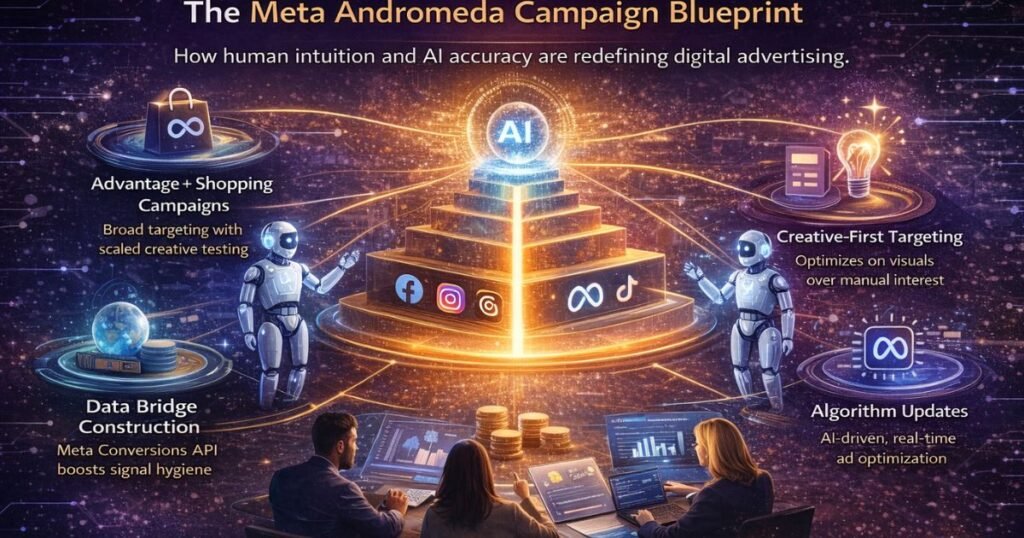
Your ads aren’t failing, Meta’s AI just outsmarted your old playbook. The Meta Andromeda Campaign is a sign of a breakthrough in digital advertising, when human intuition is used and machine accuracy is applied. Based on the Meta Andromeda update, it is a system built on the foundations of replacing the old tactics with an AI fueled ad delivery engine that is learned with every interaction. Marketers are no longer left to guess what will or will not resonate with each viewer on Facebook, Instagram, and Threads since an intelligent retrieval and ranking system can now be used to predict what particular content will or will not appeal to each viewer.
The outcome is the autopilot of creative optimization, real-time advertisements using Advantage+ campaigns and combined understanding of the new Facebook ads algorithm update. It is the intelligent new era of marketing, faster, contextual and indefinitely scalable.
This Meta algorithm change 2025 implies that machines make inferences that rely on human corrections. Imagine it is an act of GPS navigation in marketing, you tell the destination, and the AI calculates the fastest way to get there. It is not only intelligent, it is adaptive, learning with every click, scroll and pause with the help of segment aware retrieval and similarity detection.
The Meta Andromeda Update and its Implications to Marketers.
Meta Andromeda update lays out a new definition of all components of Meta ads optimization in 2025. In place of interest buckets and manual switches, the retrieval engine will rely on the user-ad relevance scoring to make predictions about what particular creative will appeal to engagement. Such change eliminates the old ways. The era of manual targeting is over, and the center of interest depreciation is growing at a high pace.
The winners? The brands adopt a broad targeting approach and use the contextual awareness inherent in AI. Regardless of whether you are advertising on Facebook, Instagram, or Threads inventory, the Meta Andromeda Campaign platform will automatically optimize reach across Reels and Stories placements and will automatically retrain to optimize conversion chances.
Out of Anarchy to Order: Campaign Unification
Simplicity fuels success. Modern Meta Andromeda Campaign is not a campaign through consolidation, but fragmentation. Gone are on the days of the 20 miniature ad sets vying over scraps. Rather, marketers use one campaign approach based on CBO vs ABO reasoning – Campaign Budget Optimization is a dynamic approach which enables the engine at Meta to allocate spend.
Combining campaigns and belief in AI/systems ideas offered by Andromeda, performance level becomes stable. The algorithm performs well when it perceives sufficient data density in order to decode signals using the Meta Conversions API (CAPI) and Events Manager. The smaller number of isolated campaigns that you execute, the more consistent your signal architecture is.
In Advantage + Campaigns, creative first targeting is used.
The age of creative preeminence has dawned. Within the framework of the Meta Andromeda Campaign, the change in the strategy is the abandonment of an audience-oriented approach in favor of content differentiation. Creative first targeting involves using emotion, color, angle and tone in lieu of filtering people. The Advantage+ Shopping Campaigns (ASC) allows even small brands to simultaneously drive dozens of creative variants – then use Andromeda to autoregressively evaluate performance on high dimensional optimization.
Effective brands use the P.D.A. model (Persona, Desire, Awareness) to create a balance in conceptual diversity in each ad set. There is no need to reach everybody, make ads that appeal to particular micro moments, the moment of curiosity awakening and the scroll halting.
Data Bridge Construction: Pixels and Signals.
All Meta Andromeda Campaigns rely on data hygiene. Even the state of the art inference speed cannot rescue ROAS without the input of solid inputs. Immediately combine your Pixel with Meta Conversions API (CAPI) to enhance signal hygiene. Such synchronization will aid Andromeda in determining the correlations between user intent and context across the model elasticity of both mobile and web conversions.
As these systems integrate, consistency in the flow of events is increased three times. That allows finer user-ad relevance scoring to increase hook rate and hold rate between placements. To make it short: its intelligence is nourished with your conversions: without them, learning falls.

Intelligent Organization of Testing vs. Scaling Campaigns.
Balance testing vs. scaling campaigns in order to prosper in 2025. Every Meta Andromeda Campaign begins on a small scale with diagnostic creative tests. Early broad targeting, hook rate (3 second views) and hold rate (ThruPlays). As soon as winners are found, scale budgets Advantage+ campaigns to leverage the complexity of Andromeda in terms of compute and real time parallelism.
This rhythm, because it involves experiment, learn, and then consolidate, enables marketers to grow ROI consistently without any form of manipulation. The powerful feedback loop maintains the high signal terms of the AI in line with the actual buyer behavior.
The Hidden Engine: The Explaination of Retrieval and Ranking.
There is more than automating under the hood of the Meta Andromeda Campaign. It does retrieval and ranking via segment aware models which are constantly updated as a result of visual hook testing and dynamic exclusions. Think of a salesperson who has a memory of all the past dialogues. Andromeda does the same, anticipating what product or creative access to the next micro moment.
Its retrieval engine gives priority to its contextual fit rather than cost as it uses high dimensional optimization to provide personalized placements immediately. That is why a sneaker advert can fit perfectly between two fashion reels – not by chance, by infallible deduction.
Its retrieval engine gives priority to its contextual fit rather than cost as it uses high dimensional optimization to provide personalized placements immediately. That is why a sneaker advert can fit perfectly between two fashion reels – not by chance, by infallible deduction.
Reading New Measurement Language.
Measures have a new language. As opposed to chasing CTR, marketers interpret the measurement language by the output such as engagement rate, hot ad bias, and half CPA strategy. Since the information updates constantly in the Meta Andromeda Campaign, it is not sensible to assess performance in a single day. Success is consistency during a period of 7 10 days.
Add this to dynamically controlled exclusions/retargeting and marketers have an understanding of what is scaling well. The rhythmic learning stages of the structure resemble the actual conversation, take a moment, listen, speak. You give algorithms patience; they give you accuracy of aim.
Meta Ads Optimization: How to Succeed in 2026.
In order to master the Meta Andromeda Campaign, reason like an architect and not a technician. What Lay did was to build the foundations with high quality creatives, feed with CAPI and allow the retrieval engine to automatically refine performance. Meds with Pattern Recognition Manual interference with pattern recognition; trust the AI-based process of delivering ads.
The ecosystem is now integrated across Threads, Facebook and Instagram ads update pipelines. Early adopters reduce their costs on watches and the participation reaches high levels. The important point is that automation is not your enemy, but it is the lack of understanding which is.
In the Future Signals: Future Prep 2026, the authors suggest a vision of the world in 2026 and provide steps to follow to achieve the goals.
What follows having mastered this Meta Andromeda Campaign blueprint? Meta (Facebook, Instagram, Threads) is likely to take Advantage+ Shopping to the next level, where they will optimize the inference speed and reduce latency using hardware acceleration. The purpose of the ecosystem is to match advertisements immediately – fewer auctions, greater accuracy of retrieval.
By 2026, advertisers who absorb the rhythm of this system data into the system, and creativity into the system, data into the system, and AI analysis into the system, will not be following trends, they will be setting them. That is the essence of the promise of Meta Andromeda, which is to transform vision into action via intelligent automation.
FAQ's
1. What is the Meta Andromeda Campaign?
The Meta Andromeda Campaign is Meta’s next‑generation advertising system driven by advanced AI. It replaces manual control with a retrieval and ranking system, interpreting user behavior, context, and signals across Facebook, Instagram, and Threads. This lets advertisers deliver highly relevant creatives automatically instead of manually segmenting audiences.
2. How is the Meta Andromeda update different from previous Facebook ads algorithm updates?
Unlike older Facebook ads algorithm updates that relied on auctions and interest targeting, the Meta Andromeda update uses deep‑learning retrieval models to predict user intent. It focuses on broad targeting strategies, creative‑first campaigns, and automated optimization through Advantage+ campaigns.
3. Does Meta Andromeda still support manual targeting and lookalike audiences?
The short answer: not really. Manual targeting is dead. While legacy tools like lookalike audiences still exist, they now act as secondary “signals” for the AI rather than audience definitions. The system’s AI‑driven ad delivery learns and adapts best when advertisers use minimal filters.
4. How should small businesses structure their Meta Andromeda Campaigns?
Small brands should favor consolidation — one campaign per objective with CBO vs ABO testing. Use Advantage+ Shopping Campaigns (ASC) and feed the AI high‑quality creatives frequently. Keep everything simple: broad ad sets, 8–15 visuals per campaign, and active signal tracking via Meta Conversions API (CAPI) or Pixel.
5. What metrics matter most in Meta ads optimization for 2026?
Forget old KPIs like CPC alone. With the Meta Andromeda Campaign, focus instead on engagement depth: hook rate, hold rate, and conversion consistency. These reflect how well the retrieval engine aligns your ad with real‑time user intent and context across placements.

1 thought on “Vision to Execution: The Meta Andromeda Campaign Blueprint From Vision to Execution”