How to make Meta Andromeda into a Machine-Learning Data Set
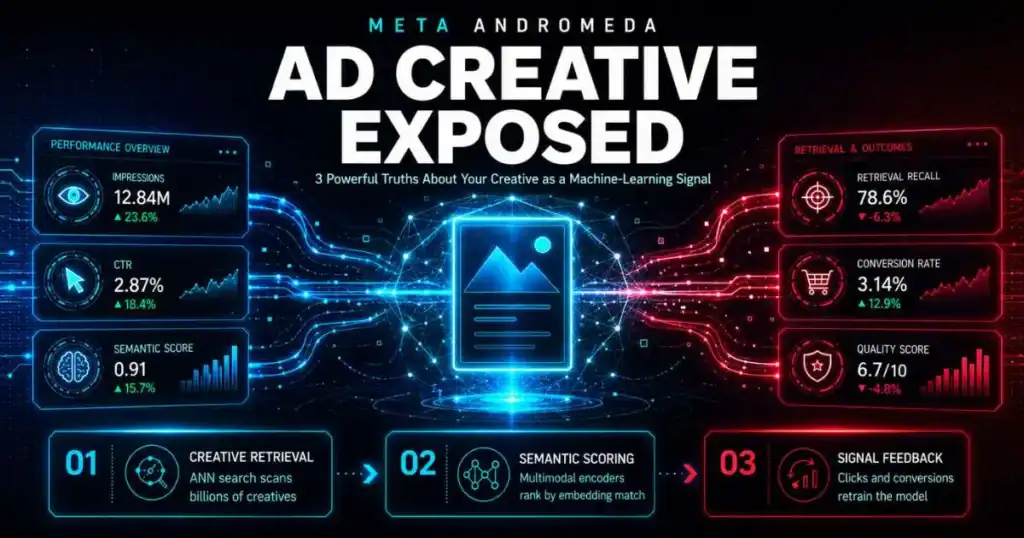
Meta Andromeda had to dispel a cosy myth that had long existed with advertisers: that creativity was cosmetic, not data. The company revamped all the headlines, frames, thumbnails, and made them inputs into a retrieval-driven machine-learning system with the implementation of Meta Andromeda. The shift in philosophy, from “rules for the audience” to “rules for the creation,” alters the metrics that advertisers optimize and how they demonstrate value.
Inside the Engine
Meta Andromeda is Meta’s production retrieval and ranking stack for ads: a two stage pipeline in which a lightweight ANN (approximate nearest neighbor) retrieval system narrows billions of creatives down to a handful of candidates to be scored by a high capacity reranker for auction. At retrieval time multimodal embeddings (visual, textual, behavioral) are stored in product-quantized indexes and retrieved by HNSW graphs in millisecond SLAs. Cross-attention models can be executed at scale with low latency on the reranker running on GEM execution modules which benefits NVIDIA’s GH200-class memory-coherent accelerators. Training involves introducing contrastive objectives for retrieval recall and autoregressive loss functions for sequential user prediction, thereby ensuring that the selection of candidates is aligned with the engagement patterns in downstream tasks.
Creative Does the Targeting
Traditional targeting was based on declared affinities and demographic buckets while creative influenced performance after it was placed. Retrieval keyspace in the case of Meta Andromeda is just the place creative embeddings belong, thereby becoming first-class citizens in candidate selection. Multimodal encoders convert an ad’s visuals and text into dense vectors that generalize to a range of contexts; retrieval will favor creatives with embeddings that are close to a user-context vector. Signals are more likely to help people find what they’re looking for when they’re compact and quick, so signals with a lot of predictive power, like precise visual anchors or short microcopy, are the ones that stand out. The impact: no longer just buying audiences; creating creatives that are aligned with the users’ latent intents.
Your Ad Talks to an LLM
Semantic density is the amount of predictive information a creative packs into a token/pixel. The multimodal encoders from Meta Andromeda are trained using contrastive and masked-prediction objectives and then fine-tuned using autoregressive sequence losses; they thus act as LLMs that translate short prompts into possible user actions. High semantic density is when, say, an image and a couple of words are together able to clearly indicate intention (e.g. image of a running shoe with text of “trail-ready” strongly correlates to the activewear intent vector). The low density is associated with ambiguous metaphors, slow narrative setups and the dispersion of signals in the latent space, which decreases the retrieval recall. In reality the system views creatives as compact prompts; the more condensed the prompt, the more likely it is to come up.
You Are Training the Algorithm
In the age of Meta Andromeda there are three pressures that brands face. The first step in brand voice is to pass the vector compression test. So basically the creative director will have to pick assets which carry the core cues (color, typography, spokesperson) in a way that the encoder can view as a stable embedding. Second, there’s the technical definition of authenticity: Creative authenticity is equated with producing semantically dense signals, not opaque storytelling. It’s a risk of human affection that takes place in slight or prolonged irony/reveal but not a risk of losing an information retrieval war. Thirdly, advertisers are unaware model trainers under Meta Andromeda. Both provide creativity, which provide impressions, clicks, conversions – modify the empirical priors of the reranker. Experiments are seen as data engineering in sophisticated teams: the A/B variants are carefully engineered, the supervision is more clear, and the sophisticated nudge mechanism affects the behavior of the system without touching the weights.
The big and the small: a new division.
Scale changes leverage. Large advertisers create lots of labeled examples which allow for specialization in the embed space and for quicker iteration. They can invest in creative ops, instrumentation, and even co-developed evaluation protocols, to speed up feedback loops. They can also contribute to custom brand adapters (small fine-tuned sets of parameters) which favour shared encoders with their stylistic signals. There are few signals in the retrieval space for small advertisers because they don’t have much volume to go around. In fact, they can compete by trying to maximize the semantic density: single-concept visuals, unambiguous microcopy, and placements with less retrieval competition. Tactical use of contextual placement or publisher affinity can be used to replace scale, and provide supplementary signals that may be used by the retrieval stage.
What's Coming Next
There will be a total of three engineering trajectories for Meta Andromeda. First, there will be more on-device / edge encoders that will deliver ephemeral user-context vectors, reducing cloud latency, privacy concerns and improving personalization. Secondly, the modality fusion will be improved: Temporal Video Encoders, Audio Embeddings and Scene-aware Representations will add to the semantic density, potentially making music/cadence a determinate signal. Third, Meta Andromeda’s infrastructure will enable larger cross-attention models on GEMs and GH200-class machines, making for more sophisticated interactions between the creative tokens and rich user histories. Training objectives will also be modified to be counterfactual and/or RLHF style, to maximize for lifetime value rather than clicks. Last, there could be a modular brand adapters/direct marketplace and paid marketplace for advertisers who wish to be considered as trainers.
Conclusion
Meta Andromeda requires some painful merging, creativity needs to be learned as art and dataset engineering. It’s not only rewarding better ads performance, it’s rewarding ads that turn into machine readable signals. In a nutshell, teams that become better and better at communicating their message and their brand in a small clear vector will gain reach and attention, teams that attempt to nuance to confuse their message and the brand will lose reach and attention. This isn’t an existential argument against creativity – more of a re-definition of craft in a world where ad systems are now being fed by LLM, and advertisers are more like pious data curators.
FAQs
Q1: What is Meta Andromeda?
Meta Andromeda is Meta’s AI-powered ad retrieval and ranking system. It uses a two-stage pipeline a lightweight ANN retrieval index and a high-capacity reranker to select and score ads based on creative embeddings rather than advertiser-defined audience targeting.
Q2: How did Meta Andromeda change ad targeting?
Before Meta Andromeda, targeting relied on declared affinities and demographic buckets. Now creative embeddings are first-class signals in the retrieval system meaning your ad creative itself determines who sees your ad, not just your audience settings.
Q3: What is semantic density and why does it matter?
Semantic density is the amount of predictive meaning packed into a creative per token or pixel. The higher the semantic density, the more clearly Meta Andromeda can match your ad to the right user intent. Low density creatives ambiguous metaphors, slow narrative setups score poorly at retrieval and lose reach.
Q4: How does Meta Andromeda read ad creative like an LLM? Meta Andromeda’s multimodal encoders are trained with contrastive and autoregressive losses the same techniques used in large language models. They treat your ad creative like a short prompt, mapping images and microcopy into a shared latent space where proximity to user intent vectors predicts engagement.
Q5: Does Meta Andromeda favor large advertisers over small ones?
Large advertisers benefit from higher conversion volume, which generates richer training signals and faster embed-space specialization. However, small advertisers can compete by maximizing semantic density concise visuals, unambiguous microcopy, and targeting placements with lower retrieval competition.
Q6: What does it mean that advertisers are now AI trainers?
Every creative that runs under Meta Andromeda becomes a labeled training example. Impressions, clicks, and conversions shift the reranker’s empirical priors over time. Sophisticated teams treat creative A/B tests as dataset engineering deliberately shaping how the system learns to surface their ads.
Q7: Where is Meta Andromeda heading next?
Meta Andromeda is moving toward on-device edge encoders, deeper modality fusion including audio and video embeddings, larger cross-attention rerankers on GH200-class hardware, and RLHF-style training objectives. A paid brand adapter marketplace may also emerge, formalizing the advertiser-as-trainer model.