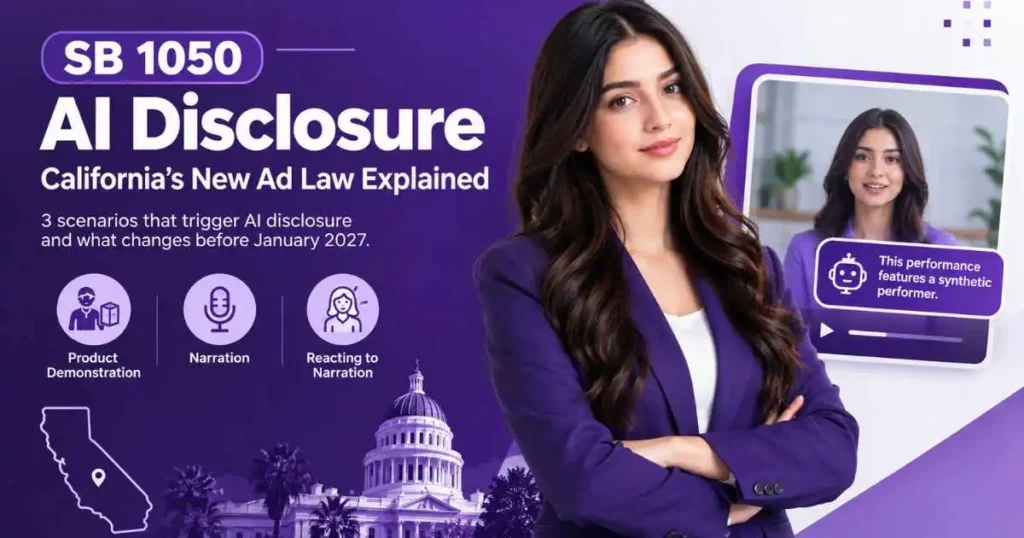
You’ve been building AI avatar ads for months, watching Meta’s own auto-detection quietly label some of them along the way. Now there’s a second layer to account for, and this one comes with actual legal weight behind it.
On September 16, Governor Gavin Newsom signed SB 1050 at SAG-AFTRA’s headquarters in Los Angeles, making California the second state, after New York, to require disclosure when advertisements use AI-generated synthetic performers. This isn’t a platform policy you can work around by switching tools. It’s state law, and it takes effect January 1, 2027.
What Does SB 1050 AI Disclosure Actually Require?
The new SB 1050 AI Disclosure requirement applies to advertisements that prominently feature an AI-generated “synthetic performer.” Under the law, a synthetic performer can be a digital figure, voice, or other representation created fully or partly with generative AI that gives the realistic impression of a human performance, while not being recognizable as an identifiable real person.
For advertisers, the key point is simple: if a commercial prominently uses this type of synthetic performer, the advertisement must include a clear and conspicuous disclosure that tells viewers the performer is synthetic. The law provides example language substantially similar to “this performance features a synthetic performer” or “no human performer is depicted.”
The SB 1050 AI Disclosure rule is broader than simply labeling something an “AI influencer.” The law focuses on how the synthetic performer is used within the advertisement. This means advertisers should review AI avatars, digital spokespersons, and AI-generated voices used in commercial creative rather than relying only on how the campaign is described internally.
The law becomes operative on January 1, 2027, giving advertisers time to review existing workflows and establish a consistent disclosure process before the new requirement applies.
The Three Scenarios That Trigger SB 1050 AI Disclosure
The SB 1050 AI Disclosure requirement centers on advertisements where the synthetic performer is used prominently. The statute identifies three situations that help determine whether a performer is considered prominent.
1. Demonstrating or illustrating the product
A synthetic performer is considered prominent when the performer appears in the foreground and demonstrates or illustrates the advertised product or service. A common example would be an AI-generated spokesperson holding a product, showing how it works, or directly presenting its features to viewers.
2. Providing the narration or commercial message
The law also covers synthetic performers that provide or voice the advertisement’s narration, whether that narration is on-camera or off-camera. This makes AI-generated voice performances an important part of an advertiser’s SB 1050 AI Disclosure review.
3. Illustrating or reacting to narration
The third situation involves a synthetic performer illustrating or reacting to narration or a commercial message delivered by someone else. For example, an AI-generated person appearing on screen and reacting to an off-camera voiceover may fall within the law’s definition of a prominent synthetic performer.
This distinction matters because SB 1050 does not simply regulate every advertisement containing an AI-generated element. The statutory definition focuses on a synthetic performer being prominently included in the advertisement. Advertisers should therefore evaluate how the AI element is actually used rather than assuming every AI-assisted creative automatically requires the same treatment.
Why SB 1050 AI Disclosure Isn’t Happening in Isolation
New York’s version of this law took effect in June 2026, and it’s already generating real consumer complaints over undisclosed AI use, according to reporting tracking the law’s early enforcement period. California becoming the second state signals this isn’t a one-off regulatory experiment, it’s the start of a genuine pattern, and advertisers running national campaigns should expect more states to follow rather than treating California as an isolated compliance island.
This also builds directly on Meta’s own auto-detection and labeling system, active since June 1, which flags photorealistic AI media in ads independently of advertiser action. An ad already carrying Meta’s automatic label and now also needing to satisfy SB 1050’s specific proximity and duration requirements means two separate disclosure standards can apply to the same piece of creative, and satisfying one doesn’t automatically satisfy the other.
The Industry Pushback Worth Knowing About
This law didn’t pass without real opposition. The Association of National Advertisers, the American Association of Advertising Agencies, the American Advertising Federation, and the Digital Advertising Alliance sent a joint letter in early September urging Newsom to veto the bill, calling it an overbroad mandatory labeling regime that exposes businesses to opportunistic litigation and places heavy burdens on ordinary commercial speech.
That opposition didn’t stop the signing, but it’s worth understanding as context. The law’s proximity and duration requirements are deliberately specific rather than a loose “somewhere in the ad” standard, partly because vaguer disclosure rules are exactly what drew industry criticism in the first place. Expect continued industry pressure and possibly legal challenges as the January 2027 effective date approaches, which means the practical interpretation of some details may still shift before enforcement actually begins.
How to Prepare for SB 1050 AI Disclosure Before January 2027
Preparing for SB 1050 AI Disclosure does not have to mean rebuilding every advertising campaign from scratch. A practical first step is to audit your existing creative and identify advertisements that use AI-generated people, voices, or digital performers.
Separate those advertisements into categories based on how the synthetic performer appears. Look specifically for AI performers demonstrating products, providing narration, or reacting to commercial narration. These are the situations directly addressed by the statute.
Next, create a standard disclosure workflow. The law requires the disclosure to be clear and conspicuous and provides example wording that advertisers can use as a starting point. Building a consistent process now can make it easier to review new creative before it goes live.
Advertisers should also keep records of which campaigns use synthetic performers and where the required disclosure appears. This creates a clearer internal review process as teams produce new AI-powered ads.
It is also important to remember that SB 1050 AI Disclosure is separate from other AI labeling systems or platform-level policies. A platform may have its own AI-related labels or detection features, but advertisers should still evaluate whether their creative meets California’s statutory disclosure requirement.
The law also contains specific exceptions, including advertisements for certain expressive works such as movies, television programs, streaming content, documentaries, and video games when the synthetic performer’s use in the advertisement is consistent with its use in the underlying work. It also excludes advertisements where generative AI is used solely for language translation of a human performer or for certain accessibility features.
Common Mistakes to Avoid
Assuming this only applies to ads explicitly marketed as featuring an “AI influencer” misses the law’s actual scope. Any synthetic performer prominently demonstrating, narrating, or reacting within an ad triggers the requirement, regardless of how the campaign is framed publicly.
Treating a brief on-screen AI label as automatically compliant is risky, since the law specifically requires a duration sufficient for a reasonable consumer to understand the disclosure, not just its momentary presence.
Assuming Meta’s own auto-detection labeling satisfies SB 1050 automatically conflates two separate disclosure standards. Confirm your creative meets California’s specific proximity and duration requirements independently.
Waiting until closer to January 2027 to start auditing existing creative risks a rushed compliance scramble across a potentially large ad library.
Conclusion
SB 1050 turns AI disclosure from a platform-level policy question into actual California law, with real consequences for non-compliant ads, including their removal from circulation. The three-scenario trigger, foreground demonstration, narration, and reaction to narration, gives advertisers a reasonably clear scope to audit against, even with enforcement details still developing.
The practical move today is simple. Audit your current ad library against the three trigger scenarios, build a disclosure template that satisfies both proximity and duration requirements, and start this process now rather than waiting for the January 2027 effective date to arrive.
FAQS
1. What is SB 1050 AI Disclosure?
SB 1050 AI Disclosure refers to California’s new requirement for certain advertisements that prominently feature AI-generated synthetic performers. The law requires a clear and conspicuous disclosure that the advertisement includes a synthetic performer.
2. When does SB 1050 AI Disclosure take effect?
The SB 1050 AI Disclosure requirement becomes operative on January 1, 2027. Governor Gavin Newsom signed SB 1050 on September 16, 2026.
3. What counts as a synthetic performer?
Under SB 1050, a synthetic performer is a digital figure, voice, or representation created in whole or in part using generative AI that creates the realistic impression of a human performance and is not recognizable as an identifiable natural person.
4. Does every advertisement that uses AI need an SB 1050 AI Disclosure?
Not necessarily. The law focuses on advertisements that prominently include a synthetic performer. The statute specifically describes prominence as a performer appearing in the foreground while demonstrating or illustrating a product or service, providing narration, or illustrating or reacting to narration.
5. What wording can advertisers use for SB 1050 AI Disclosure?
The law says the disclosure should use wording substantially similar to “this performance features a synthetic performer” or “no human performer is depicted.” The disclosure must also be clear and conspicuous so that a reasonable consumer can notice, read, and understand it.
