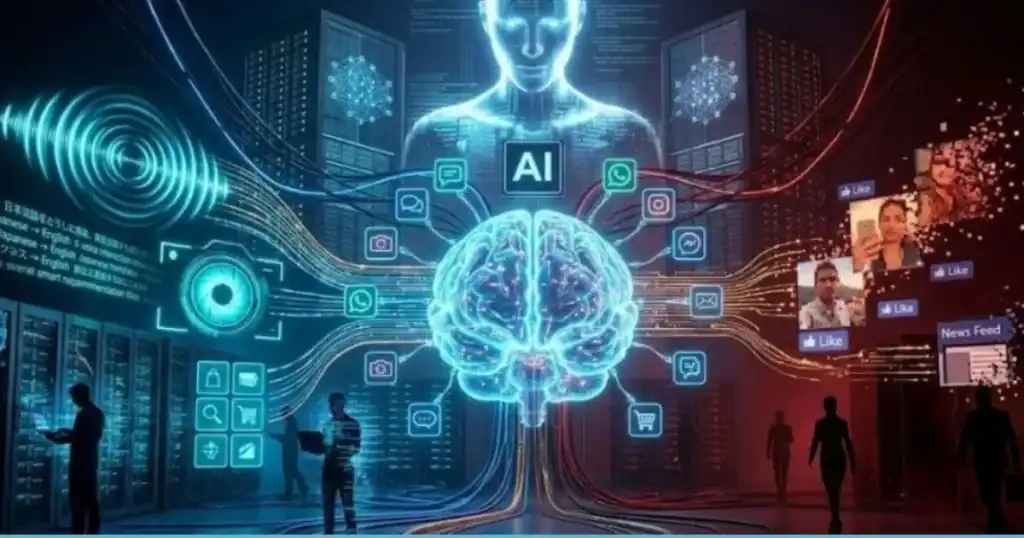
Meta AI transformation 2026 marks a historic shift in how one of the world’s largest tech companies operates. Meta is making a drastic effort to reinvent itself as a tech company focused on artificial intelligence. For years, it was known for its news feeds, selfies and social graphs, but it now wants to be an AI-first company and create products that people use on a daily basis.
This Meta AI transformation 2026 is drastic and ambitious. Meta is transforming itself through a big new product launch, a massive reshuffle of jobs, an eye-catching spending budget, new AI-driven consumer features, and a sweeping guarantee of “personal superintelligence.” But will the company’s business model provide useful products – or just rehash the tech landscape at massive social expense?
The Muse Spark launch and why it matters (Meta AI transformation 2026)
Meta’s new batch of AI models and developer tools, Muse Spark, was announced early in 2026 as part of the Meta AI transformation 2026 to be the successor of Llama. Muse Spark is designed to deliver the tools required to build AI applications. Muse Spark isn’t merely a new model launch. It’s an ecosystem with optimized models, multimodal (text, voice, image) app toolkits pre-integrated, hosting and inference services, and platform-level APIs that simplify the integration of Meta’s AI into consumers’ experiences.
What it means: Muse Spark is Meta’s indication that the company will come to own a bigger piece of the AI puzzle. For developers, it offers convenience: models that are pre-trained for tasks such as summarization, voice interaction, and live camera analysis by using Meta’s infrastructure. For consumers, it’s the foundation behind capabilities that are embedded in the apps they already use – Facebook, Instagram, Messenger, WhatsApp and the entire Meta ecosystem.
Open Source to Closed System
Meta’s new batch of AI models and developer tools, Muse Spark, was announced early in 2026 to be the successor of Llama. Muse Spark is designed to deliver the tools required to build AI applications as part of the Meta AI transformation 2026. Muse Spark isn’t merely a new model launch. It’s an ecosystem with optimized models, multimodal (text, voice, image) app toolkits pre-integrated, hosting and inference services, and platform-level APIs that simplify the integration of Meta’s AI into consumers’ experiences.
Layoffs and Retooling & What the Job Moves Reveal
Priorities shift quickly. Meta is shifting resources to areas it feels are strategically important: AI Model Development, Infrastructure, and Product Integration. Roles will not disappear, but will change. Workers are being either re-specified or moved to new roles that integrate AI, or they risk losing their jobs. Transitions will be painful. A loss of job has a personal impact and brings up issues of social protection, retraining and the cost of fast technological shifts.
The tandem of layoffs and redeployment indicate that Meta is betting that AI will become a pivotal part of its business going forward and that it’s transforming internally to reflect that change.Meta AI transformation 2026: AI in Your Daily Apps
Meta AI Transformation 2026 is no longer developing models for other developers, it’s starting to put them in users’ hands. These key features slated for 2026 reveal the company’s expectations of where AI will make an impact.
Voice Mode: Conversational control throughout apps whether it’s composing a message, asking for a summary, or giving directions all in the language of speech.
Live Camera: Real-time visual understanding, enabling apps to identify scenes, make recommendations, translate text in photos or offer shopping links of what you point your camera at.
Private or ephemeral AI helpers within messaging, capable of drafting replies, summarizing chats and generating content without a persistent personal profile (Meta claims).
Shopping Mode: AI-based product discovery and personalization, which filters feeds and camera search to recommend products, compare pricing or even direct you to the most suitable purchase.
These features offer convenience: quicker communication, smarter search and real-time help. They also highlight privacy and safety concerns, such as the duration of data storage, the training of models, and the possibility of personal interactions contributing to the improvement of commercial models.
The larger vision "personal superintelligence" explained (Meta AI Transformation 2026)
Meta AI Transofrmation 2026’s moniker is “personal superintelligence” and is a simple word for a complex concept. It can be imagined as a very capable digital assistant customized for you, who will remember your preferences, draft messages for you, arrange your daily life, summarize content, teach you new things, guide you in shopping, and even provide emotional support or decisions suggestions. It’s “super” because it is more intelligent and proactive than the assistants of today, and “personal” because it’s tailored to your context and habits.
This might seem like:
Less time on repetitive tasks assistant drafts and follows up on your behalf.
Better decisions with fast comparisons and intelligent suggestions.
Increased accessibility for creativity: AI can assist in writing, editing images or creating presentations.
That is, however, with some conditions. Personalization requires data. When all that data is collected by one company, there are risks involved: Profiling, unwanted ads, misuse or security breaches. There are also society questions: When many people use personalised AI, who will be responsible for the bias, and in what way to keep human judgment?
Mixing excitement and risk (Meta AI Transformation 2026)
The prospects for Meta AI Transformation 2026 are bright, and they’re not without their dangers. Muse Spark and integrated consumer features are promising signs of a genuinely useful tool that has the potential to change how people live their lives everyday. The reorganisation and significant spending highlight its importance to the future of Meta. But the pullback from open-source, large-scale job cuts, and investments in size and scope of business bring challenging questions on fairness, safety, and corporate power.
A question that needs to be kept by the horns: If companies such as Meta are able to create and successfully develop “personal superintelligence” who will dictate what it can do and how can we prevent it from being used to limit freedom?
Conclusion (Meta AI transformation 2026)
The Meta AI Transformation 2026 marks a shift from social media to AI leadership.
Meta is embedding artificial intelligence into every user experience through Muse Spark, Voice Mode, Live Camera, and personal superintelligence.
However, the Meta AI Transformation 2026 raises critical questions about privacy, job displacement, and corporate power.
The Meta AI Transformation 2026 will reshape the tech landscape.
Its success depends on responsible innovation and strong safeguards for users.
FAQs
What is Meta AI transformation 2026?
Meta Andromeda transformation 2026 represents Meta’s strategic shift from a social media company to an AI-first technology company. It encompasses new AI models, developer tools, consumer features, and organizational changes designed to integrate artificial intelligence into users’ daily experiences.
How does Meta AI transformation 2026 differ from previous Meta initiatives?
Unlike previous AI efforts focused on backend optimization, Meta Andromeda transformation 2026 directly integrates AI capabilities into consumer-facing applications. It includes features like Voice Mode, Live Camera, and Shopping Mode that put advanced AI tools directly in users’ hands.
What are the main features of Meta AI transformation 2026?
The core features include Voice Mode for conversational control, Live Camera for real-time visual understanding, private AI helpers within messaging, and Shopping Mode for AI-based product discovery and personalization.

1 thought on “Meta AI transformation 2026: From Social Media Giant to AI Powerhouse”